Tag Archive for Success

Boss Requires Relationship Management Too

While you probably think of management as the relationship you have with the people who work for you, management is a two-way street and your boss requires some relationship management too.  Even if you’re an entrepreneur, you may have a similar relationship with a board chair or someone else in your sphere of influence.

First of all, it’s important to understand that managing the boss is not selling out or acquiescing to anything.  Managing the boss and thinking about how best to do that does not mean you love everything she/he does.  This is like so many other issues we discuss in career coaching.  There’s a balance, so be smart!

Let’s start with an easy one.  You have a responsibility to try to make your boss look good.  When you do your job well, she has an opportunity to shine with her boss.  You can also go beyond doing your job well to taking something off the boss’s plate – something that she doesn’t particularly like to do – and making her look good.

Don’t become indispensable to your boss.  In other words, it’s nice to take the occasional task off boss’s plate; however, not so much that you become indispensable.  If you do that, you could become someone, he will not promote because he couldn’t bear to lose you.

Think about managing your boss as finessing the boss.  Ask yourself what does he/she value, how does she think or what motivates him?  If you have an understanding of what makes her tick, you’ll be better able to manage and finesse your relationship with the boss.

A very important way to advance at work is to demonstrate that you have ideas for change and solutions to problems.  These ideas, however, are only as good as the ability to sell them and get them implemented to prove your value.  Think about your boss, what is her communication style or workplace lingo.  Talk to her in a way that speaks to her communication style as the best way to sell your ideas.

I have always found that keeping one step ahead of the boss at work is a great way to be recognized and rewarded.  Everybody has a full plate; everybody is busy.  If you can stay a step ahead of your boss, anticipating his/her needs, then you are more likely to please the boss and get ahead.

So you see, it’s all about relationship, like so many things.  Management is not just for your subordinates; management also applies to your coworkers, colleagues and your boss.  Regardless of whether your boss is a man or a woman, these basic rules for relationship management apply.

Employees and bosses both have their issues, because we’re human and certain personality chemistry clicks while other personalities might clash.  At work, this is not about being friends, this is about learning to examine the situation, how you can lead within your team and manage your relationship with your boss.

Please give me a call at 513-561-4288 or connect with me via email at kay@highheeledsuccess.com, so we can empower you to achieve that goal.

Risk-Taking 101: Find Balance

 “You can’t be successful in business without taking risks.  It’s really that simple.” 

–Adena Friedman, President and CEO of Nasdaq

Taking risks is necessary in business; however, you don’t want to be the one who jumps into anything or the one who lags behind and misses an opportunity.  Hopefully, after thinking this through with me, you’ll be able to find your sweet spot – being both confident and completely aware as you make a risky decision.  If you have any questions, after reading this, I’m always here to coach and support you!

First of all, there are three types of risk-takers:  jumpers, ruminators and sweet spot riskers.  Jumpers don’t exercise due diligence.  Jumpers are unrealistic about the circumstances, their resources and possibly time management.  Jumpers might be unrealistic about the potential revenue, haven’t thought about how time consuming something is and generally have blinders on.

For example, I had a client who was starting a business.  She chose to spend an excessive amount of money for website, rent office space hired an expensive staff member.  She has been working overtime just to cover her expenses and has not been able to turn a profit.

Ruminators tend to go over and over information, stalling and failing to make a decision.  Ruminators are driven by fear.  The numbers make sense, yet they do more research and more research.

Sweet spot riskers – that’s where you want to land by finding balance between facilitating the necessary due diligence and moving forward because the facts present themselves.  You have what you need to make a clear, reasoned and thoughtful decision.

When you have an opportunity that requires risk and are trying to follow a process that will help you find the correct level of risk, think QCAT as the acronym to find your sweet spot.

Q for Quick – be quick but not hasty and set a timeline for decision making

C for Committed – be committed, but not rigid, and if new data presents itself that suggests a change of direction, be ready to change

A for Analytical – be analytical, but do not over analyze and use data to push through fear

T for Thoughtful – be thoughtful, but not obsessive

Personally, I tend to be more of a ruminator.  When I first started my own business; however, I was a “jumper.”  So I’ve experienced the extremes and have used these exact same techniques over the years to find my own sweet spot for risk-taking.

If you would like to walk through these steps with someone who has been there and are eager to make a greater impact in your career, it would be my honor to be part of that process with you.  Please give me a call at 513-561-4288 or connect with me via email at kay@highheeledsuccess.com, so we can empower you to achieve that goal.

Emotional Intelligence is a Critical Factor for Success

Self-Awareness, Emotions, Empathy at Work

While you might not think much about the topic of emotional intelligence, it’s an issue that comes up frequently during my individual client sessions.  Putting your best foot forward as an emotionally intelligent boss and co-worker is a need in the workplace, a need for anyone who manages people.

By definition, emotional intelligence is the capacity to be aware of your feelings, being in control of them and able to express them.  For example, if you’re going to succeed with challenging employees, the administrator needs to set the tone.  The administrator needs to serve as the model for what you want others to emulate.

Historically, the foundation of emotional intelligence was laid when Daniel Goleman, Ph.D., wrote his 1995 book, Emotional Intelligence (Bantam Books), which helped to explain the differences between traditional IQ (intelligence quotient) and EI.  The book was on The New York Times bestseller list for a year-and-a-half and is available around the world in 40 languages.

The next major resource to come along was the book Emotional Intelligence 2.0, written by Travis Bradberry and Jean Greaves, Ph.D., which provides case studies, tools and techniques to improve your emotional intelligence.  In fact, Dr. Greaves is co-founder and CEO of TalentSmart, Inc., and the website talentsmart.com is a great resource to learn more.

Now, emotional intelligence is very much part of the fabric and conversation in any workplace.  If you work in a large company, you could probably talk to the human resources department to find out if you have taken or could take a formalized EI assessment.  When assessing EI, you’ll be looking at overall social awareness, relationship management and your ability to empathize with others.

If you find an area is lacking in yourself or your employees, there are strategies for improvement and some people can benefit from identifying an EI mentor – someone who seems to get along and understand others.  A mentor can be responsible for queuing you if you talk too long or if you misread communication.

For example, if an employee has negative reactions to someone else’s behavior and there is emotional fallout due to low self-awareness, this situation needs to be managed.  Or if you find employees want to leave a department because they don’t want to work with her, or headaches and stomach problems are being caused by a difficult co-worker, these situations need to be managed too.

5 Components of Emotional Intelligence

  • Self-awareness
  • Self-regulation or emotional control
  • Motivators
  • Empathy
  • Social skills

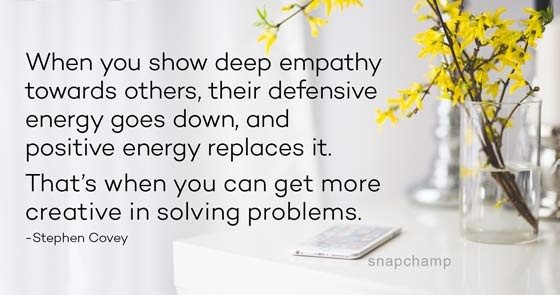
covey-quote


When it comes to social and relationship skills, we’re not just talking about charm.  As human beings interact with each other, we need to be able to interpret voice, facial expressions and body language.

Certain careers, such as information technology, engineering and research, require a high IQ; however, without emotional intelligence, success can hit a certain ceiling.  Both qualities are needed to be successful.  From Abraham Lincoln to Temple Grandin and Bill Gates, there have been many recognizable people who have lacked relationship skills.

Whether you decide to take a self-assessment or talk to a colleague for mentorship, it’s critical to identify where you have strengths or where you might need some emotional intelligence work to do.  A perfect opportunity to dig in on this topic is during your next job review.  Is there a tool or can your boss provide some guidance in this area?  A performance review is a gift to both the employee and the employer, so be smart and take advantage to help you put your best foot forward!

If you are eager to make a greater impact in your career, it would be my honor to be part of that process with you.  Please give me a call at 513-561-4288 or connect with me via email at kay@highheeledsuccess.com, so we can empower you to achieve that goal.

©Copyright 2018.  Kay Fittes.  All Rights Reserved.

Don’t Let Women’s Unique Vulnerabilities Get in Your Way

It’s February, the middle of winter…blah, blah, blah, am I right?!   While we’re plugging along at work and also juggling the many roles women have, we often struggle to take care of ourselves.  Valentine’s Day and Heart Health Month remind me that this is the most important time to be sure that we value and love ourselves first.  My mentor mantra for women is: Take care of yourself, so you can be the best version of yourself with your family and in the workplace.

Throughout my decades-long career of coaching women to achieve the next level of success, I have become very aware of the fact that women have their own unique vulnerabilities.  While we strive to achieve c-suite level careers and equal pay in both the corporate and non-profit sectors, along with increased opportunities to start our own businesses, we cannot ignore that women’s life stages and ever-changing roles are unique.

My High-Heeled Success® list of women’s unique vulnerabilities is below.  Please read the list and honestly assess which of these eight characterize you and don’t flip out if they all do.  That’s not uncommon.  Think of this as a self-assessment, and maybe pick one or two that you can work on right away.

Women’s Unique Vulnerabilities

  • Tendency to belittle and de-value themselves
  • Strong need for perfectionism
  • Allowing emotions and feelings to color their experiences
  • Doing more than one task at a time
  • Assuming much responsibility from role overload
  • Difficulty relinquishing control
  • Difficulty nurturing self
  • Taking stress everywhere they go

Now that you’ve taken time to focus on yourself, to assess yourself, you’ve taken a high-heeled step or a track shoe leap in the right direction.  The beautiful thing, the loving thing is to care for yourself this Valentine’s Day and every day.  When you take this time for yourself, hopefully doing for others – whether it’s volunteering at the local homeless shelter, helping a child with his or her class valentines, planning a night out or caring for parents or in-laws – will bring you more joy.  Without time for you, the caring can reap resentment.

As long as you acknowledge what our unique vulnerabilities are, note them and think about how you can manage them, you will be surprised by how the results will also impact your work-life balance and your career success.

If you are eager to make a greater impact in your career, it would be my honor to be part of that process with you.  Please give me a call at 513-561-4288 or connect with me via email at kay@highheeledsuccess.com, so we can empower you to achieve that goal.

©Copyright 2018.  Kay Fittes.  All Rights Reserved.

Fall Focus with New School Year Excitement

No matter what the season or the stage of your career, balancing work and life successfully can always be challenging.  With the start of the new school year and fall just around the corner, this can be the season to renew and refresh your career goals.  At the start of the summer, we focused on the need to find your high-heeled equilibrium during the summer months when attitudes relax.

As July and August come to a close, work, school, volunteer and really everything seems to rev up to get back to business.  This new attitude allows for a fresh start; however, you now have opportunity to hang onto the summer balance tools that may have worked especially well for you.

For example, if being in nature was something you discovered as restorative this summer, make it a priority to continue to enjoy the outdoors.  Maybe you found that being less tethered to your electronics was a new discovery that allowed you to switch gears, enjoy the moment and even sleep better.  If you found that worked for you, keep it up!  Summer often forces us to find ways to simplify.  If you managed to feel positive effects from simplification, keep doing whatever worked for you.

In short, let’s approach your career guide for fall, like you would approach the excitement of starting the school year.  Remember what it was like to go back to school in the fall – everything was fresh and new.  You might have been excited about your new school shoes or excited about making new friends, either way, remember what excited you about this time of year.

If you were like me, you would wonder what new information you might learn in the coming year.  Just writing this column, I’m reminded of that feeling.  I’m challenging myself and challenging you to think about what new, exciting opportunities and challenges might be facing you in your career and in your life.  Is there a new technology you want to learn?  Do you need to be more assertive in the workplace?

If new friends are something you looked forward to in the new school year, think about your workplace relationships, both internal and external.  Take this opportunity to focus on new goals with your relationships.  Maybe you’ll decide to take lunch with a work friend or set your sights on developing a new mentor.  Whatever the goal, fall can be the time to refresh your plans.

When I was a kid going back to school in the fall, my parents took me to St. Louis to go shopping for new school clothes.  The brief family trip was full of tradition.  We went to the zoo and a baseball game.  The ritual provided the reset I needed.

As an adult, you can decide that a fall refresh involves reinventing your image and/or your wardrobe, deciding you need to update your style or sharpen your focus.  As a professional woman, monitoring your body language and the signals you send could be the reset you need.  (Watch for a more extensive conversation about body language and what it transmits in a future issue.)

As the regular school/academic year calendar pace picks back up, whether you have children at home or not, take advantage of this opportunity to renew and refresh with the same excitement you had as the new school year started in the fall.  Whether you’re wearing your high-heels or your fuzzy slippers, take time to keep what worked for you in the summer and sharpen your career focus to best suit your own personal needs.

If you are eager to make a greater impact in your career, it would be my honor to be part of that process with you.  Please give me a call at 513-561-4288 or connect with me via email at kay@highheeledsuccess.com, so we can empower you to achieve that goal.

©Copyright 2017.  Kay Fittes.  All Rights Reserved.

Finding Balance When You Want to Wear Flip-Flops

Successfully balancing work and life are always challenging, yet finding your equilibrium in high heels can be even more challenging as attitudes shift during the summer months.  The entire work world seems to redirect a certain amount of focus toward summer life style and vacation, and you might find you want to swap your high heels for your flip-flops.

There are unique circumstances to consider in the summer as you plan to take vacation, do more at work while someone else is on vacation and possibly juggle out-of-school children while maintaining your normal work schedule.  Let’s dig our toes into the sand and ponder how you can take advantage of this time to improve your work-life balance.

It’s summer, so the pace at work will likely slow down a bit.  At the same time, there will likely be fewer people pulling the weight at the office.  You and your co-workers will renegotiate the office work load to be sure everything is covered and your client needs are being met.

Nothing is more frustrating for a customer or client to find out that a deliverable is on hold while their primary contact is on vacation.  With planning, a team can cover for each other and allow everyone to go on vacation with peace of mind to enjoy a complete break from the office.

As the pace slows, take this time to assess how well you are balancing your busy work and home life.  Seriously take stock and ask yourself if you tend to overschedule, find it hard to ask for help or let go of control at work and at home.  Self-awareness will go a long way toward helping you find your work-life balance.

As the pace slows, you can also time to assess your own schedule, everything you do and why, and start to dream about the life design you want.  Life is too short to do something just because you were asked or you have a hard time saying no.  If everything seems important, you need to learn how to identify the real priorities and be satisfied with your achievements.

Your day-to-day mental health is paramount.  If you begin experiencing increased fatigue, headaches, stomach problems, anxiety, anger or insomnia, it’s time to make yourself the highest priority.  When it comes to taking care of yourself, you need to take time to connect with others.  Ask yourself if you’re spending time with people and doing the activities that provide support or that undermine support, then do what’s needed to invest in yourself and create more relationships and situations that support you.

To take more time for yourself, you will need to take something off your plate.  Realistically, ask yourself what would you be willing to take off your plate?  If you took that thing off your plate, what would you be willing to do for yourself?  This is the only way to take actionable steps toward assessing your work-life balance and creating change.

Finding equilibrium and knowing when to take off your high heels and put on your flip-flops is best achieved when you avoid being the martyr or sacrificing yourself when you need to be delegating and asking for help.  When you do for others that which they can rightly do for themselves, you rob them of opportunities to raise their self-esteem and sense of competence.

In addition to your colleagues at work, use this strategy at home with the kids.  Think about having a summer chore list – having a family plan for everyday household tasks will teach your children a great life lesson.  We all need to feel needed – even kids need to know that they are contributing.  By not doing everything for them and having them contribute in age appropriate ways, your children will have their own sense of accomplishment.

The regular school/academic year calendar has a faster pace for everyone, whether you have children at home or not, so take advantage of this opportunity to slow down your pace.  If you do have children at home, it’s beneficial for you to slow down the pace with them.  Remember work will always be there tomorrow.  In the meantime, life is waiting.  Whether you’re wearing your high heels or your flip-flops, take time to enjoy the summer — reflect, vacation and spend time with the people and doing the activities that give you pleasure.

If you are eager to make a greater impact in your career, it would be my honor to be part of that process with you.  Please give me a call at 513-561-4288 or connect with me via email at kay@highheeledsuccess.com, so we can empower you to achieve that goal.

©Copyright 2017.  Kay Fittes.  All Rights Reserved.

Think Strategy Before You Say ‘Yes’

April was National Volunteer Month – a time to honor all the volunteers that contribute of themselves to improve our communities.  The month also brings attention to volunteer recruitment, so maybe you’ve been thinking more about how you might contribute your time and talent.  Our time is our most valuable gift, so I encourage you to differentiate strategic volunteerism that provides leadership enhancement opportunities vs. other volunteerism for altruistic reasons.

Volunteerism for altruistic reasons is personal and leads you to a cause that provides pure personal satisfaction, such as serving in a soup kitchen.  While this is very important too, I’ll focus on strategic volunteerism to help you choose volunteer positions with visibility in mind.

The most obvious and accessible path is to choose opportunities within your industry or field of expertise, such as a professional association.  An example would be women in commercial real estate getting involved with Commercial Real Estate Women (CREW).  Stepping up to serve in professional organizations is especially important if you’re working in a male dominated field, such as engineering.

Once you’re settled in a volunteer position, don’t be shy about it.  Broadcast your volunteer leadership roles in emails to the boss, at annual review time and even in social media.  Unfortunately, women are less willing to toot their own horns, yet we absolutely must to be recognized and advance.

Look around your community, read the news about accomplished business leaders and the organizations they serve.  If you are more thoughtful about determining who in a volunteer position is a powerful leader, then you can go after opportunities to lead with them.  Think about the leaders you want to know, and find a volunteer situation that meets your other parameters.

Some volunteer positions can help you advance professionally and gain certifications.  Toastmasters is the volunteer experience that provided this opportunity for me.  I was already a seasoned presenter when I joined Toastmasters 20 years ago; however, I was joining to further develop my leadership skills.

I believe I have held every office in our club, serving several terms as president.  Additionally, I served as an area director for our district.  My volunteer job was a perfect match for the skills I wanted to hone – to develop leadership in others.  In a volunteer organization, there are no bonuses or raises, so you must find ways to inspire your colleagues.

In my business, I wanted to become a leader of leaders, a developer of talent.  The goal to be able to recognize the spark, then fuel that spark into greater leadership.  Gradually, I developed step-by-step ways to hone in on the spark and groom the right person for leadership succession.

As I moved up to take more responsibility within Toastmasters, I became a more skilled delegator.  Eventually, I was an area director, overseeing several clubs, coaching and developing other leaders.  I had successfully leveraged my volunteer role with Toastmasters into one that provided exactly what I needed professionally.  I developed better delegation skills, better meeting planning and execution skills, effective talent search and development in creating a succession plan both as a president and as an area director.

While I was taking my own skills to a higher level, I was also helping others, which is the pure essence of volunteerism.  The opportunities with Toastmasters provided both the feel-good opportunity to volunteer and serve others at the same time I was growing my own skills and taking my leadership abilities to the next level.

If you are eager to make a greater impact in your career, it would be my honor to be part of that process with you.  Please give me a call at 513-561-4288 or connect with me via email at kay@highheeledsuccess.com, so we can empower you to achieve that goal.

©Copyright 2017.  Kay Fittes.  All Rights Reserved.

Self-Limiting Behaviors

Have you reached your full potential in your current situation? While my focus is typically on women’s career success, a personal life review (particularly at this time of year) also merits some healthy introspection. We were born with an unlimited capacity to think, create, achieve and love.  Through the innumerable situations we experience, we either ‘grow and go’ or ‘slip and slide’.  The difference in our reaction is locked within our thinking patterns and self-belief, which combine to form limiting behaviors that either propel us forward or keep us grounded firmly in fear.  A limiting behavior or belief can be like a broken record or set of tapes that play a continuous loop in our minds, typically in our subconscious.  They are riddled with negativity.  Sometimes we are vaguely aware of them, often they’ve been there for so long we just accept them as the norm.  Let’s explore.

What are the top limiting behaviors?  In my over 25 years experience in working with women in all levels of management, three limiting beliefs rise to the top again and again.  They play out in the professional world, to be sure, but can also play a significant role in our personal lives.

1.  Not enough self-love – This is the number one issue so many women face.  It’s also the best-kept secret many women hide.  You would be amazed at the number of powerful women I have coached over the years whose outward presence, confidence and communication style exude success.  Yet, when we dig a little deeper, sometimes just beneath that seemingly solid shell, what lies beneath is a lack of self-love.  The reasons are manifold; a childhood issue, an unresolved relationship, a past (perceived) unforgivable error, and the biggest culprit – the comparison game.

The common thread among each reason is also the most important yet challenging thing to accept; the past cannot be changed.  A perfect upbringing is virtually nonexistent. Relationships and errors of the past are ancient history; most often only thought of in the prisons of our own mind.  Granting forgiveness to someone that hurt you, or to yourself for a past error is one of the biggest gifts and favors you can give yourself.  Doing so enables negative feelings to flow out and positive thoughts and the beginning to self-love to take root.

You are a masterpiece of your past; from the genes you received at birth and the formative years of learning to life experiences and choices, you are who you are.  Small changes are possible, but for the most part what you see is what you get; both in the mirror and in your mind.  My point?  Stop the comparison game!  Embrace who and what you are (the good and bad) and use it all to the best of your ability.  You will never be the best ________________ or the worst ____________.  Fill in the blanks for yourself.  With almost 7.5 billion people on the planet and over 330 million in the US, this is an undeniable truth.  Accepting yourself as who you are and were created to be is the beginning of self-love and one step away from self-limiting behaviors.

2.  Not enough ‘other-love’ of other women – If we suffer from the comparison game (and I think it’s safe to say we’ve all afflicted at some point) it festers on the inside, but worse, it creates significant damage in its outward manifestation.  Negative thoughts and energy don’t just sit in a vacuum.  They flow outward and reach others whether in body language, written or verbal communication, or in the way we treat people.  And no one is immune.  Just as we have our own strengths and talents to use, the same is true for other women.  However, if you play the comparison game, it is one of the biggest barriers to collaboration, creativity, achieving a mission and bonding.

When we busy ourselves not liking ‘her’ because she speaks up for what she wants, maybe a better approach is to appreciate the assertiveness skills that can be helpful in bringing a negotiation to a close.  If you don’t like that ‘she’ is too bossy, try to appreciate that someone can lead others to get the job done.  Ultimately, remember that those same women (and men) all have their own insecurities and self-doubt.  This applies to women in all areas of our lives; business colleagues, relatives, neighbors, in volunteer situations, etc.

Instead, make a commitment to stop comparing, and replace those thoughts and feelings with acts and words of empowerment.  You will be amazed at the difference in your own thinking and feeling, in the relationships you have with other women, and in their behavior.  For example, when you publicly recognize someone for a job well done the positivity has a domino effect.  Your positivity reflects well on yourself and feels good, the recognition is both motivating and affirming to the person receiving it, and others are motivated to both do well and emulate your behavior.  Such positive outcomes won’t happen immediately or spontaneously, but over time the payout will create an environment where everyone feels more loved, accepted and able to reach their fullest potential.  Ultimately, working harmoniously and practicing ‘other-love’ for women will dispel and help eliminate limiting beliefs and thinking.

3.  Now, claim your power! – After clearing the way for positive thoughts for yourself and toward others by emptying out negativity and eliminating the comparison game, it’s time to claim your power!  That’s right!  Your power; it lies deep within you and was there from the moment your conception.  Think about it – what a process to become a human being.  That’s a lot of power. Learning to eat, talk, walk, run, think and other life skills; that all takes a lot of power.  When we are young and full of imagination, we believe we can do and become anything.  Yet, somewhere along the way, we begin to collect untruths, limiting beliefs and restrictive behaviors, which all combine to hold us back and restrain our power.

The good news is that the same power we were born with, tapped into as a young child and now call upon occasionally still resides within us.  But, oh do we have our reasons for letting it lie dormant.  Although we want to be successful in our career and other important areas of our lives, so many women hold back due to fear of success.  At first glance, it’s a paradox.  If we possess the power to achieve, what are we waiting for? Why hold back?

No one answer is the same or true for each woman, but I have discovered a common list:

  • If I succeed at first, how will I continue, and will I have the strength to keep it up?
  • What will others think of my success, and how will they treat me, especially if it means a promotion?
  • What if I claim my power and fail at what I try?
  • What if I make the wrong decision either in the short or long term?
  • It won’t feel safe or secure, and I will be out of my comfort zone.

Fear of failure or use of personal power often leads people to ask for more information before they will decide to move forward.  It makes people stuck.  If you feel stuck, I would love to help you work out a plan of success to move forward. Please give me a call at (513) 561-4288  or connect with me via email at Kay@highheeledsuccess.com or so we can tap into your power together!

©Copyright 2016.  Kay Fittes.  All Rights Reserved.

Standing out in the Crowd

Gaining a competitive edge in today’s business world requires a unique combination of skill, experience and the ability to stand out in a crowd.  Searching for a job, shining in your company, or being an industry expert; these activities and goals require various and many talents to be sure.  However; making your mark requires more than skill and experience.  You have to be truly unique to rise above the competition and stand out in the crowd; a daunting task.  In a society with pervasive social media noise and 24-7 news feeds, and a business climate saturated with voicemail and email overload, standing out in the crowd is challenging at best.  So how do you do it?

Deliver the unexpected.  In the business environment, this can range from a creative resume or job search approach to going above and being truly unique in the workplace.  The Huffington Post recently highlighted a young Australian job-seeker who created a candy bar wrapper out of her resume and sent it out on a chocolate bar to would-be employers.  When the story hit the news, she received offers from as far away as Europe.  Someone else I know sent her resume along with three copies of US News & World Report’s top-rated hospitals issue when applying for a marketing job at Cincinnati Children’s.  She shared how she would like to contribute to their marketing efforts to help keep them in the number 3 spot in the country.  Unique and unexpected; these two candidates stood out above the crowd.

In your daily job, experts give so much advice on how to stay ahead of the pack and get noticed.  ‘Under promise and over deliver’ is oft-quoted guidance.  Also popular are; be on time, work hard, be professional, stay goal-oriented, etc.  While these are solid ideas, the one I believe will make the greatest impact is effective communication skills; both speaking and listening.  In John Maxwell’s book Everyone Communicates, Few Connect, he maintains that “The ability to communicate and connect with others is a major determining factor in reaching your potential.  To be successful, you must work well with others.  To do that at your absolute best, you must learn to connect.”  Being powerful in your communication is unique in the workplace.  If you want to stand out above the crowd, try listening more and talking less.  You’ll be amazed at the attention and people it draws.

Now, let’s turn our attention to standing out in the crowd as a speaker.  In my experience as a speaker and an audience member at any event, I have found one common thread that garners the most attention – delivering the unexpected.  The element of surprise –  something that catches people off guard, makes them pause and think, or knocks them of their normal course of thought; these are the things that cause you to rise up above the crowd.  I have two personal stories of the unexpected; one giving, the other receiving.

I attended a James Malinchak Speaker Bootcamp in Los Angeles one year, and wanted to get noticed among the hundreds of attendees that would be there.  In researching his bio, I learned that James was a former UC basketball player under coach Tony Yates, whom my husband knew through a friend.  Prior to heading to LA, I purchased UC spirit items and made a gift bag for James, and obtained permission from Tony to give his cell number to James.  When the opportunity arose at the bootcamp, I presented James with the gift and shared Tony’s number.  James was absolutely blown away by the gesture because it had been years since they last spoke, and Yates had had a profound impact on James as a coach.  No doubt, this connection was memorable for James and it definitely made me stand out in the crowd.  He referenced me many times over the course of the bootcamp, and in doing so I made 10 times the connections than I typically do at such events.

Just a few weeks ago, after joining a coaching program, they followed up with the unexpected.  I was surprised when UPS delivered a package one day, as I hadn’t recently ordered anything.  To my pleasant surprise, the organization sent a surprise gift to me as a new member.  I had absolutely no idea it was coming, and the bonus of this gesture increased the value of the investment I’d made with the program.  The unanticipated event made them stand out above myriad other membership programs I’d joined in the past.

As a speaker and presenter, passion, humor, and storytelling are the top three elements of delivering the unexpected to my audiences.  People are wowed when I come in from the back of the room with boxing gloves asking, “Do you come out punching every time you speak?”  This combines a little bit of humor with the unexpected.  Women love the red vinyl shoes I use to mark the way to the training room for public workshops.  This is storytelling in a sense, in that it connects with how to achieve High-Heeled Success.  I’ve been known to use many props in my workshops, some humorous, some to drive home an important point, and others to underscore an idea I am passionate about.  One of my favorite props is a wand that lights up and plays a magical chord when I wave it (thanks to Jenifer Quin-Wilson for the gift of the want).  The wand is an unexpected object that underscores breakthroughs, ‘ahah’ moments, and steps of courage that many women take when they grow and develop in my workshops.

Are you delivering the unexpected in what you do every day?  If you need help standing out above the crowd I’d love to help.  We can explore ways to develop your presentation skills, increase your passion, your delivery or storytelling skills.  Connect with me via email at kay@highheeledsuccess.com, or give me a call at (513) 561-4288.

©Copyright 2016.  Kay Fittes.  All Rights Reserved.

Unrealistic Expectations

Self-expectations are one of the biggest stumbling blocks challenging many women I coach.  Pressure to perform to a certain level on a daily basis in work, career and home or personal life can be overwhelming.  In this month that we celebrate love, I’d like to demonstrate how easy it is to fall away from loving ourselves and suggest some paths back to realistic expectations, which provide opportunities for self-growth and care.  Let’s begin by exploring the ‘ideal’ day.

In your quest to perform, deliver and achieve, are the expectations you put on yourself attainable or loaded with unrealistic vignettes that fill and overflow your life?  What does your perfect day look like?

Here’s one for you:

  • Arise at 5:00 (after going to bed at 9:00 pm).
  • Have a healthy breakfast.
  • 5:30 yoga.
  • Ready, energized and out the door (in the perfect outfit) by 7:15.
  • Arrive at work and take some quiet time to think and plan your day while sipping a skinny latte.
  • Spend the morning in deep concentration to complete a project which is due in three days.
  • Give a late morning presentation showcasing your department’s recent achievements and an outline for continued success.
  • Eat a nutritious lunch.
  • Engage with several colleagues in a fruitful brainstorming session for an upcoming project, offering many thought-provocative ideas.
  • Finish the afternoon getting a solid head start on a project due next week.
  • Leave work at 5:00.
  • Prepare a healthy dinner with ingredients from a fully-stocked fridge and pantry.
  • Check a few things off your ‘to do’ list for your home/personal life.
  • Spend the remainder of the evening engaging in meaningful relationships or enriching activities.

Do you feel that only after you have accumulated weeks and months of your version of the ‘perfect day’ that you will have it ‘all together’ and possess the discipline needed to be successful?  I have coached many women who feel that anything short of a rigid schedule, and specific daily accomplishments means they have to ‘start over’.  They literally found themselves ‘throwing in the towel’ day after day if they didn’t accomplish certain things within a given timeframe.  Many women perpetuate these behaviors for years before coming to terms with how unrealistic and hard they are being on themselves.

The problem with this thinking is that the ‘perfect day’ doesn’t take into account real life, allow other people to enter our circles, or allow us to be ‘human.’  Unscheduled events happen daily.  Things like oversleeping, emergency meetings, not making it to the grocery store, crisis management, interruptions, traffic jams, the needs of significant others, illness and countless other real-life events.  These things keep us from the perfection we seek, and they will always exist.  Yet, many women constantly fight this uphill battle by trying to strategically devise ways to achieve everything on their ‘to do’ list, and place unrealistic burdens upon themselves that are only achievable in edited movies or airbrushed ads.

Do you find yourself in this situation?  If so, take your version of the ‘perfect day’, and place it on a loved one’s plate.  Would you expect your spouse, significant other, child, sibling, friend or parent to reach the same expectations day after day without fault?  Most likely not, and if they fell short of their own self-expectations you would likely be the first one to advise them not to be so hard on themselves and cut themselves some slack.

Today, I offer the same advice to you – begin to love yourself more by throwing away one or two unreasonable expectations.  Maybe for you, it’s giving up the fact that you can’t keep a perfectly clean house or apartment, post an enlightening article on Linked-In every week, or continue to volunteer at the same level you have been.  Take a look at your January calendar, or three months prior if possible, and place your to-do items in a four column list.  Below are some examples:

1

2

3

4

Non-Negotiables

Necessities

Electives

Unreasonable Expectations

Work

Well check-ups

Volunteering

Every meal nutritious

Pay bills

Car maintenance

Girls’ night out

Perfectly completed work projects

Grocery shopping

Home upkeep

Hobbies

Consistently early bedtime

Eating

Continuing Ed

Vacation

Size 2 clothing


Just looking at all the items together should begin to eliminate any notion of having to ‘do it all’.  Keeping our untold amount of responsibilities and activities flowing flawlessly is impossible.  Scrutinize the activities in columns 3 and 4. Beginning with just one item, make a plan to eliminate some of your unreasonable expectations, or reframe them.  For example, instead of shooting for perfect nutrition at each meal, perhaps you stop snacking after 8:00pm, or leave a few bites on the plate.  Similarly, instead of delivering the perfect PowerPoint at work, perhaps it’s 85% ‘there’ when submitted, providing necessary room for feedback, and making room for other important things in columns 1 and 2.

Take a good, hard look at column 3 and see what activities are not serving you well, especially those you feel are sapping your personal time or energy.  Volunteering is great on many levels, but in doing so at this point in your life, are you neglecting responsibilities in columns 1 & 2 just to live up to your own unreasonable expectations?  Your list of elective activities might also include watching TV, social media or other time sapping actions.  If you find little room in your day for things you’ve listed in columns 1 & 2, it’s time to unburden yourself of unrealistic expectations and open up some room for a little self-love instead.

We experience the most stress when the gap between our self-expectations and reality is wide.  Start by changing two or three small things.  Doing so will make an impact big enough to feel, but also provide the feeling of not losing complete control.  Need help with both the practical and mental aspects of simplifying?  I can help put a plan together to streamline your professional and personal life, and provide the tools you need to stay on track.  Through the process, I can help you be accountable to your commitment and provide guidance to get back on track if needed.  Email me today to get started, and take that first step toward loving yourself, and your life, more.

©Copyright 2016.  Kay Fittes.  All Rights Reserved.